Mystery Spot Santa Cruz
Posted on
New Listing RPPC Mystery Spot Santa Cruz, California Postcard Strange & Mysterious Unposted. Buy It Now +$1.00 shipping. Journey Into Mystery. Journey Into Mystery #83. Swarovski Spotting Scope Spotting Scopes. Leave feedback about your eBay search experience - opens in new window or tab.
Mystery Spot Santa Cruz Photos


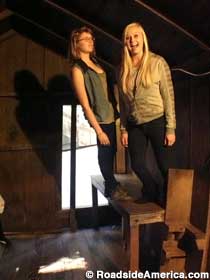
Santa Cruz 'Mystery Spot'Explained By Patricia McBroom, PublicAffairs Magnetic anomalies emanating from the Bermuda Triangle.Anti-gravitational forces caused by UFOs. An 'ineffable,natural phenomenon that cannot be described or explained.' Supernatural gabble gushes from the house of illusions inSanta Cruz known as the 'Mystery Spot,' one of more than adozen places in the nation where stunning visual illusionscompel people to reach for metaphysical explanations todescribe their experiences. At Santa Cruz's 'Mystery Spot,' balls roll uphill, chairssit on walls and people lean over so far they can't seetheir shoes, yet they don't fall down. Nineteenth-century psychologists had theories to explainillusions like this, but the explanations left considerableroom for mystery. Now, Berkeley psychologists have generated a new theorybased on experimental data that goes much further inexplaining all the effects of the phenomena knowncollectively as 'the mystery spot.' Central to their thesis is a new emphasis on the humanneed to establish horizontal and vertical orientations andthe extent to which people take their cues from theimmediate context if they can't see the earth's horizon. 'All the visual illusions in the Mystery House derivefrom the fact that the house is tilted,' said WilliamPrinzmetal, adjunct associate professor of psychology. Heconducted the studies with colleague Arthur Shimamura, alsoa psychology professor. 'You know the house is tilted, but you don't know howmuch. Everything is tilted. You can't look outside and get ahorizon, so you think that what you see is right. It's verycompelling,' said Prinzmetal, an expert on perception whohas been to the Mystery Spot a dozen times. Although he hasstudied these illusions, he said his visual perceptionsstill are distorted when he goes into the house, which istilted at a 20-degree angle from the ground. It doesn't take a scientist to know that cockeyed roomsaffect perception. If floors are slanted, for instance,people will hang pictures on a slant. But what has not been known before is that when theperceiver's body also is tilted, the distorting impact onvision is greatly magnified -- up to two or three times theeffect of slanting the visual field alone. 'In the tilted condition, you are much more affected bythe immediate visual context,' said Prinzmetal, who hastested dozens of subjects in a laboratory chair tilted at a30-degree angle. In that position, he tests their ability toline up vertical dots in a slanted matrix in a darkened roomwhere they have no clue to the true horizon. With theirbodies tilted, he said, people's perceptual distortion morethan doubles, compared to when they see the same matrix froma level chair. 'We are such visual animals,' said Prinzmetal. 'Themechanism in us that's responsible for determining thehorizontal and vertical is mostly affected by what we see.If the context is screwy, that will throw off what we see asvertical and horizontal.' He said that other cues to people's horizontalorientation, such as the vestibular system in the inner earand bodily sensations of gravity, appear to become lessfunctional in the tilted condition, leaving visual contextas the dominant cue. Prinzmetal contends that understanding the principles ofthe Mystery Spot is critical for understanding other visualillusions that have remained unexplained for more than acentury. These illusions can make lines appear longer or shorterthan they are, or straight lines appear curved and curvedlines appear straight, among other distortions of reality. Many of these visual illusions are also increased bysitting in the tilted chair, said Prinzmetal. One critical application of the new research is toimprove the flying of airplanes. All cockpits carry an 'artificial horizon,' essentially aleveler, that pilots use when the real horizon is notvisible. It is the only clue to the horizon when the cockpitis tilted -- as the chair was tilted in the laboratory.Pilots are trained to ignore the visual context of thecockpit and fasten their eyes on the leveler. Unfortunately, they don't always follow that rule, saidPrinzmetal, adding that planes have crashed because thepilot thought he was flying level when actually he was at anangle. That is said to have happened in one story circulatingthrough government aeronautic circles. According to thetale, the last words heard on the tape retrieved from acrashed airliner was the navigator shouting, 'Look at yourartificial horizon!' and the pilot responding, 'I can't.It's broken!' Prinzmetal said that scientists at the NationalAeronautics and Space Administration, with new appreciationfor the strength of these visual illusions, now are workingto make the displays for artificial horizons much moreobvious. . |
Mystery Spot Santa Cruz United States
This site is produced and maintained bythe Office of Public Affairs, University of California,Berkeley. |